The Traditional Medicine Practice Council says massage and spa businesses must be licensed before they open their doors, and enforcement has now reached Ashanti Region.
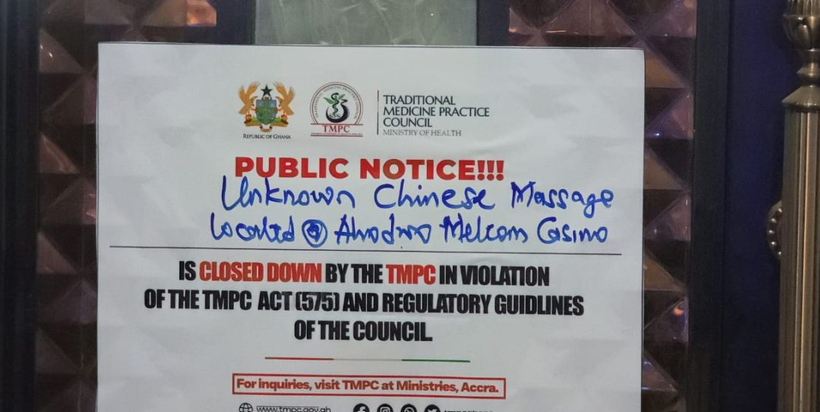
Three massage spas run by Chinese nationals in the Kumasi Metropolis have been shut down for operating without a licence, the state body that regulates traditional and alternative medicine in Ghana has said.
The facilities are located at Ahodwo and Daban, two well-known neighbourhoods in Kumasi. They were closed during an enforcement sweep targeting massage therapy centres, spas and similar businesses.
Who ordered the closures
The action was taken by the Traditional Medicine Practice Council (TMPC), the government agency that licenses and supervises traditional medicine practitioners and allied services, including massage and spa operations.
Divine Azraku, the Council's Ashanti Regional Regulation Officer, said the businesses had opened without first obtaining a TMPC licence, as reported by MyJoyOnline.
"Most of them were Chinese," Mr Azraku said, adding that foreign nationals working in the sector "are supposed to acquire our licence, that's TMPC licence, before they can operate."
He said the problem was not limited to a few outlets. Nearly every facility the team inspected during the exercise lacked the Council's licence. "Almost all of them did not have our licence," he said.
The enforcement team closed the affected premises and pasted caution notices at the entrances so that customers and the public would know the businesses were not cleared to operate.
What the law requires
Mr Azraku set out the basic paperwork anyone who wants to open a spa or massage centre in Ghana must have in place.
First, a business operating permit. Second, an association card or some other proof of proficiency in the trade. Third, documentation showing that the operator has real experience in the profession.
Only after those requirements are met can the Council issue its licence. Without it, the business is operating outside the law, no matter how modern the premises look.
Why it matters
Massage and spa services have grown quickly in Ghana's bigger cities over the past few years, especially in middle-class areas of Accra and Kumasi. Ahodwo and Daban are both parts of Kumasi where such businesses have become common.
Because the service involves physical treatment of clients, the Council's position is that practitioners must demonstrate training and competence before they take money from the public. Licensing is the mechanism for checking that.
For Ghanaians abroad who invest in small businesses back home, or who send family members to run them, the case is a reminder that sector-specific regulators exist beyond the usual company registration. A business certificate alone does not cover a spa.
The Council has described the Kumasi operation as part of a wider push to bring massage and related facilities into compliance. It has not said publicly how long the closed spas will remain shut, or what the three operators must do to reopen.