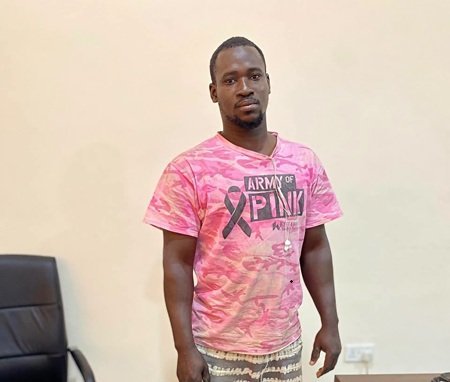
The policy analyst says Lebanese statements on the airport bust make no mention of Ghanaian narcotics officers, raising questions about whether it was truly a joint operation.
Policy analyst Bright Simons has publicly challenged the explanation given by Ghana's Narcotics Control Commission (NACOC) for a cocaine seizure at Beirut's Rafic Hariri International Airport, saying the Lebanese version of events does not match it.
NACOC, the state body mandated to control narcotics in Ghana, said in a statement on Sunday that the arrest in Beirut came out of a "controlled delivery" operation run with Lebanese drug law enforcement. A controlled delivery is a tactic where investigators knowingly allow a suspected drug consignment to move on, under supervision, so that the people at both ends of the chain can be identified and arrested.
Simons, as reported by Daily Guide Network, argues that the Lebanese record tells another story.
Who actually handled the bust
According to Simons, Lebanese reporting shows the seizure was handled by Lebanon's General Security and Customs, not the country's anti-narcotics unit. That unit sits within Lebanon's Internal Security Force (ISF), and he says it normally issues its own statement and is named whenever it takes part in a joint operation.
He pointed to past joint operations involving Saudi Arabia, Qatar, Kuwait and the United Arab Emirates, where Lebanon's Central Office for Drug Control was named directly. In this case, he said, Beirut Customs never mentioned cooperation with Ghana in any of its statements or interviews, describing the operation instead as coordination with Lebanese General Security after monitoring and intelligence work.
Lebanese Prime Minister Nawaf Salam also praised the two Lebanese agencies for sharing information, Simons noted, without referring to Ghana.
The bribe question
For Simons, the strongest signal that something does not add up is the allegation of a bribe. He said Lebanese Customs sources told broadcaster LBCI that the passenger is suspected of having paid a bribe at Accra airport to get two suitcases through.
His point is simple: if NACOC had already authorised the bags to pass as part of a controlled delivery, the process would have been supervised under Ghana's Act 1019, cleared by NACOC's Director-General, and Ghana Airports Company Limited (GACL) security would have been alerted before screening. In that situation, he asked, who would have needed to ask for a bribe?
He added that Lebanon has similar requirements under Law 673/1998, where Articles 214, 219 and 220 require the ISF counter-narcotics branch to be directly involved in controlled deliveries.
Prior knowledge is not the same as a joint operation
Simons accepts that Lebanese Customs had spoken to Ghanaian Customs and aviation security and already considered the Syrian courier suspicious. But he says that is not proof of a controlled delivery, because NACOC, the only Ghanaian agency empowered to authorise one, was never named.
He linked the prior suspicion to the fact that the man had entered Lebanon from Syria through the Masnaa land crossing and was already under Lebanese surveillance before flying to Accra and returning days later.
Finally, he said video of the search shows Lebanese officers appearing surprised by the packaging and hidden compartments, adjusting X-ray settings and commenting on finding airtags. Had Ghana supervised the transit, he argued, they would have been briefed in detail in advance.