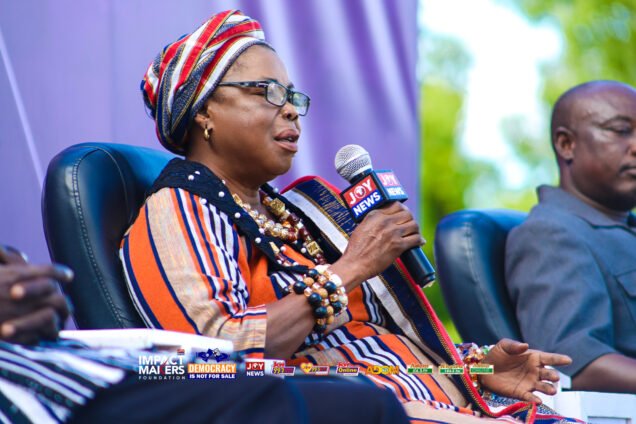
Alijata Haruna says economic hardship in the Savannah Region makes cash and gifts from politicians hard for many women to turn down.
The Queen Mother of the Damongo Traditional Area, Alijata Haruna, says the reason some women in the Savannah Region accept money and gifts from politicians during elections is simple: they are poor, many never had the chance to go to school, and jobs are scarce.
She made the point on Friday, September 25, at a public forum in Damongo under the theme "Democracy is Not For Sale", organised by JoyNews. Adom Online reported her remarks.
What she said
The Queen Mother was answering a question about why many voters now treat cash handed out during campaigns as an ordinary courtesy, even though such gifts can shape how people vote.
Her answer pointed to daily survival rather than ignorance of the law. When a woman is struggling, she said, a piece of cloth or a hundred cedis is not an insult — it is help she needs at that moment.
"I think one of the issues or the fundamental issue is about the poverty level of the women and then also the illiteracy rate," she said, adding that the Savannah Region records a high rate of illiteracy among women.
She listed three factors together — poverty, illiteracy and employment — as the roots of the problem, and argued that fixing those conditions matters more than lecturing women about their choices.
Why this matters
Vote-buying is one of the recurring worries in Ghanaian elections. Small cash payments, cloth, food items and other gifts are commonly reported around campaign season, and civil society groups have long argued that such inducements weaken the idea of a free choice at the ballot box.
The Queen Mother's contribution shifts the conversation from blame to economics. If a voter's decision can be swayed by an amount as small as GH¢100, the argument goes, the deeper issue is how little that voter has to begin with.
Her position also carries weight because of who she is. Queen mothers in Ghana hold recognised authority in their traditional areas, particularly on matters affecting women and children, and their voices often reach households that formal civic education campaigns do not.
About the forum
The "Democracy is Not For Sale" series is designed to open public discussion on electoral integrity and the practices that undermine it. Other speakers at the Damongo engagement included the Savannah Regional Minister, who called for stronger public education on the issue, while stakeholders at the forum pushed for collective action against vote-buying.
For Ghanaians following the country from the United States and elsewhere, the discussion is a reminder that election integrity at home is tied closely to household income, school enrolment and the availability of work — especially in regions such as Savannah, where those indicators lag behind the national picture.