A commentary argues that peace today depends less on full agreement between nations and more on their ability to keep talking through their differences.
The world has never been more linked by trade, money, information and migration. Yet governments are finding it harder than ever to agree on what to do about the problems they share.
That tension is the subject of an opinion piece published by The Ghana Report, which argues that peace in the current era is not simply the absence of war. It is about whether countries can keep talking to one another, manage their disagreements, and find the narrow spaces where cooperation is still possible.
Global problems, national decisions
The core difficulty set out in the piece is a mismatch. Climate change, migration and food insecurity do not stop at any border. But the decisions needed to deal with them are still taken mostly at national level, by governments answering to their own voters and their own interests.
At the same time, wars and rivalries between big powers are reshaping relations between states, with competition over energy, technology, trade and strategic resources adding to the pressure.
What the agreements show
Two international deals are cited as examples of both the promise and the limits of working together.
In 2024, member states of the United Nations adopted the Pact for the Future, an agreement meant to strengthen international cooperation and make global institutions better able to handle new challenges.
The Paris Agreement on climate change is the other example. Countries signed up to a shared framework, but turning that framework into real action depends on governments continuing to cooperate even when their national interests pull in different directions.
The piece describes that gap between signing and doing as the real test of multilateralism, the practice of countries solving problems jointly rather than alone. Implementation, it argues, rests on political will, trust and a willingness to compromise.
The questions from developing countries
There is also a fairness question that will be familiar to readers in Ghana and across Africa. Developing countries have asked whether existing global institutions give enough weight to their interests, and whether those institutions reflect how the world economy has actually changed.
Technology cuts both ways
Artificial intelligence, cyber capabilities and digital platforms are changing how societies communicate and how conflicts start and spread. They can open new routes to cooperation. They can also spread disinformation and widen existing divisions.
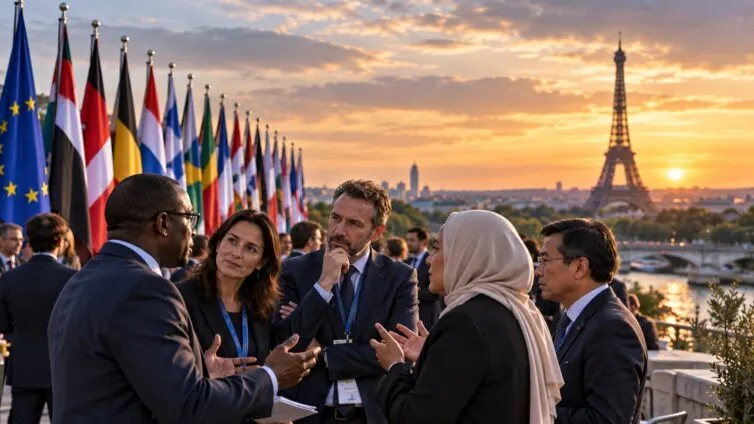
For that reason, the piece argues, future peacebuilding cannot be left to diplomats alone. Governments will need to work with scientists, journalists, technology firms, international organisations and civil society groups. The Paris Peace Forum is named as one platform where such conversations take place.
The conclusion is modest rather than idealistic: the goal is not to remove disagreement, which is unrealistic, but to keep enough trust alive so that disagreement does not harden into permanent confrontation.