A Cargill Ghana and International Cocoa Initiative apprenticeship scheme in Western North is pitching vocational skills as a practical answer to child labour in cocoa communities.
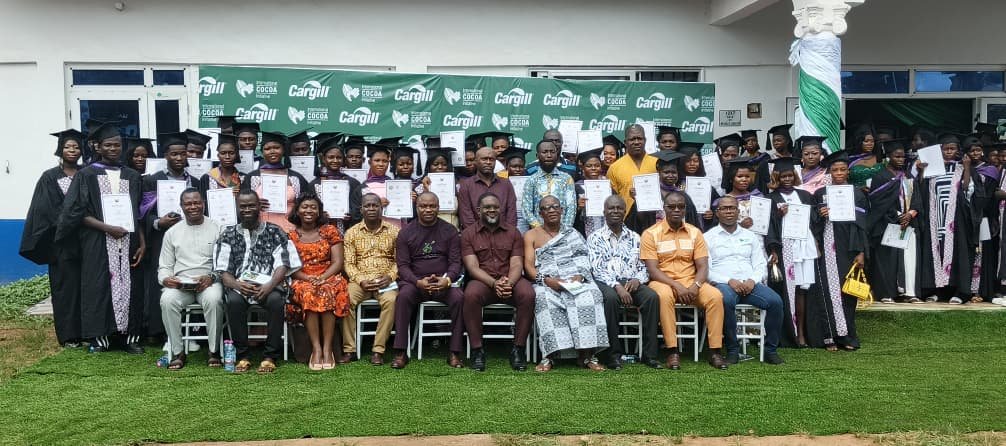
One hundred and eleven young people in Ghana's cocoa belt have completed vocational apprenticeships and gone home with start-up tools, in a scheme that links youth employment directly to the fight against child labour on cocoa farms.
The graduation took place at Debiso in the Western North Region, and was organised by Cargill Ghana together with the International Cocoa Initiative (ICI), a non-profit that works on child labour and forced labour in West Africa's cocoa sector. The graduates trained between 2023 and 2026, according to MyJoyOnline.
Who graduated, and in what
The group was made up of 75 women and 36 men. Their trades include auto mechanics, carpentry, welding, tailoring and dressmaking, baking and glass fabrication.
Each graduate received a set of start-up tools. That detail matters: for many apprentices in Ghana, finishing training is not the hard part \u2014 buying the first sewing machine, welding set or mechanic's kit is. The tools are meant to move the graduates straight from training into self-employment or paid work.
This is the second batch under the programme. The first cohort of 60 graduated in April 2025 at Sefwi Bekwai, also in the Western North Region, bringing the running total to 171 young people trained.
The child labour argument
The organisers frame the training as prevention rather than charity. The reasoning is that where young people in farming communities have no route to further education or a trade, households stay poor and children end up working on farms.
Max Essoh Latte, Managing Director of Cargill Ghana, said the company sees the future of cocoa as tied to the wellbeing of growing communities, and that equipping young people with skills addresses "some of the underlying factors that can contribute to child labour".
ICI Country Director Mike Arthur made a similar point, saying access to vocational skills within communities "can provide stronger pathways towards economic independence".
Samuel Apana, Sustainability Operations Manager at Cargill Ghana, urged the graduates to use their skills to create openings for others, not just for themselves.
Government response
Dr James Kofi Kutsoati, Deputy Chief Executive in charge of Operations at the Ghana Cocoa Board (COCOBOD), said the programme complements the Cocoa Sector Child Labour Monitoring System (CS-CLMS), COCOBOD's own framework for identifying and removing child labour from cocoa farms. He said the system has recorded significant progress over the years and called on stakeholders to keep working together.
The ceremony drew traditional and community leaders, parents, master craftspersons, government representatives and development partners.
Why it matters beyond Ghana
Cocoa remains one of Ghana's biggest foreign exchange earners, and buyers in Europe and North America face tightening rules and consumer pressure on child labour in supply chains. For Ghanaians abroad watching the sector, schemes like this are part of how the industry defends its access to those markets \u2014 though 171 trainees is a modest figure against the scale of the challenge.