President Mahama has given security agencies two weeks to produce a plan for stopping drugs from moving through Ghana’s ports and borders.
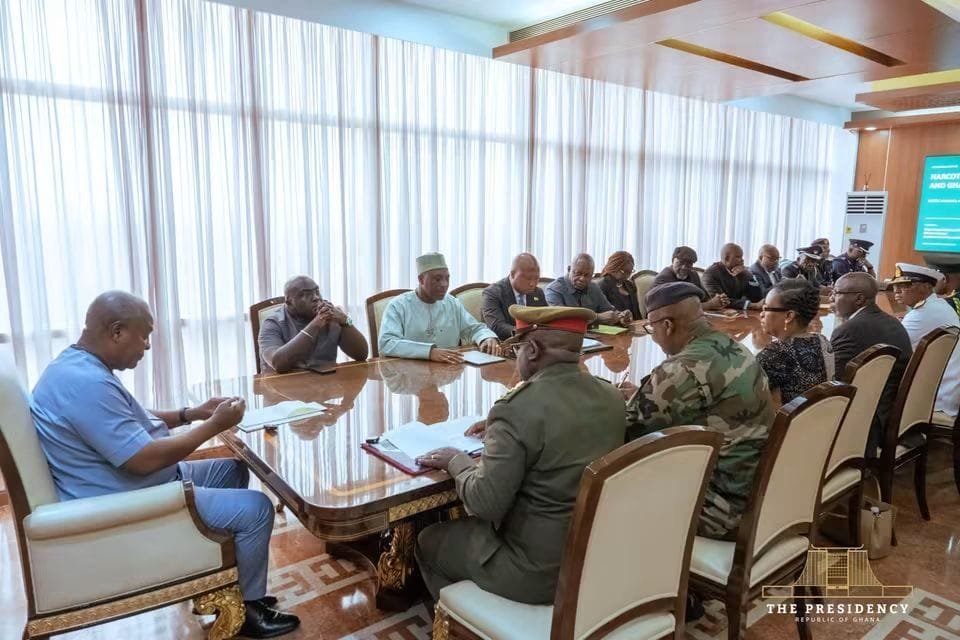
President John Dramani Mahama on Wednesday chaired a meeting of Ghana's security chiefs on the recent trafficking of narcotics out of the country's ports, and was told that ten people are currently in custody as investigations continue.
Four of those being held are officers of the Customs Division of the Ghana Revenue Authority (GRA), the state body responsible for collecting taxes and controlling what enters and leaves the country through the ports and borders.
What the President ordered
After receiving the briefing, the President directed that an inter-agency task force be set up. The task force is to draw on the discussions from the meeting and produce a detailed roadmap on how to stop drugs from being moved through Ghana's borders.
The deadline is two weeks.
The meeting also went over the existing structures and security systems at the ports, and put forward recommendations for new action. The source report does not name the agencies that will sit on the task force, nor does it set out what the recommendations are.
Why it matters
Ghana's ports at Tema and Takoradi, along with Kotoka International Airport, are the main gateways for the country's trade. When narcotics are found to have passed through them, the damage is not limited to the criminal case at hand. It raises questions with foreign customs services and law enforcement partners about whether cargo and passengers leaving Ghana are properly screened.
For Ghanaians in the United States and elsewhere, that is the part of this story that lands closest to home. Shipments, personal effects and travellers coming out of a country under scrutiny can face tighter inspection, longer delays and higher costs at the receiving end.
The fact that serving customs officers are among those detained also points to the harder problem the task force will have to confront. Scanners, cameras and paperwork controls only work if the officials operating them are not part of the chain. Any credible roadmap will have to deal with internal complicity, not just equipment.
What happens next
Three things are worth watching over the coming weeks.
First, whether the ten people in custody are formally charged and arraigned, and on what counts. Detention during an investigation is not the same as prosecution.
Second, whether the two-week roadmap is published or kept internal. A public document would allow shippers, exporters and the wider public to see what is actually changing at the ports.
Third, whether the GRA and the Customs Division take any separate administrative steps, such as suspensions or internal disciplinary processes, alongside the criminal investigation.
None of the detained persons has been named publicly, and no one has been convicted of any offence in connection with the matter.
Reported first by Ghanaian Times on 2026-09-17. This article was written for our readers based on that report. Follow the link for the original coverage.