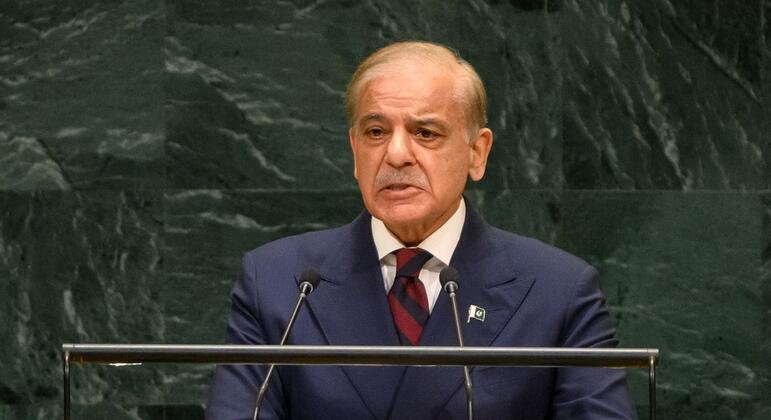
Prime Minister Shehbaz Sharif used Pakistan’s slot at the UN General Debate to warn India over a river treaty, raising fresh worry about two nuclear-armed neighbours.
Pakistan's Prime Minister Shehbaz Sharif has told world leaders at the United Nations that any move by India to stop, block or divert Pakistan's share of the waters of the Indus River would be seen as an act of war.
He made the statement on Friday during the General Debate of the UN General Assembly, the yearly session in New York where heads of state and government each address the world body. UN News reported that he described the Indus river system as the lifeblood of Pakistan and of the wider region.
The dispute over the treaty
India and Pakistan share the Indus river system under a long-standing treaty. Mr. Sharif said India's decision to place that agreement in abeyance — that is, to suspend its operation on its own — has "no legal basis whatsoever". He said UN experts and the Court of Arbitration, an international tribunal that settles disputes between states, had rejected India's position.
"Water must never be weaponized. Rivers should nourish nations, not divide them," he said.
For readers following from a distance, the significance is simple: both countries have nuclear weapons, and water is the resource millions of farmers on both sides depend on.
Last year's fighting and Kashmir
Mr. Sharif said Pakistan acted in self-defence under Article 51 of the UN Charter when it faced what he called external aggression from India a year ago. He credited United States President Donald Trump with stepping in to prevent a full war between the two countries.
He argued that avoiding another such moment requires settling the dispute over Kashmir, saying Kashmiris have waited eighty years for a UN-supervised vote on their future. He accused India of illegal occupation, arbitrary detention, extrajudicial killings, enforced disappearances and collective punishment.
On religious tension in India, he said Hindutva ideology driven by the Rashtriya Swayamsevak Sangh (RSS), a Hindu nationalist organisation, was fuelling lynchings, communal violence and attacks on places of worship.
Gulf, Gaza and Afghanistan
Speaking on the conflict that shook the Gulf in February, Mr. Sharif said Pakistan had hosted talks in Islamabad that brought Washington and Tehran together. He insisted the Strait of Hormuz and the Bab el-Mandeb passage in the Red Sea must remain open — both are shipping routes that affect global fuel and goods prices. He condemned recent Houthi attacks on Saudi Arabia, including an attempted drone strike on Mecca.
On Gaza, he named an eight-year-old girl, Wafa Akilah, killed on what should have been her first day of school, and asked whether a child born in Gaza does not deserve the same future as any other child. He said forced evictions of Palestinians in the West Bank reflect what he called Israel's genocidal agenda.
He also called on Afghan authorities to take "verifiable, decisive action" against terrorist groups he said were using Afghanistan as a base to destabilise Pakistan.
Closing on the session's theme of restoring trust, he said Pakistan had chosen dialogue over confrontation and peace over war.