The 18-month project aims to keep ship repair work — and the money that follows it — on the West African coast instead of sending vessels to Europe or South Africa.
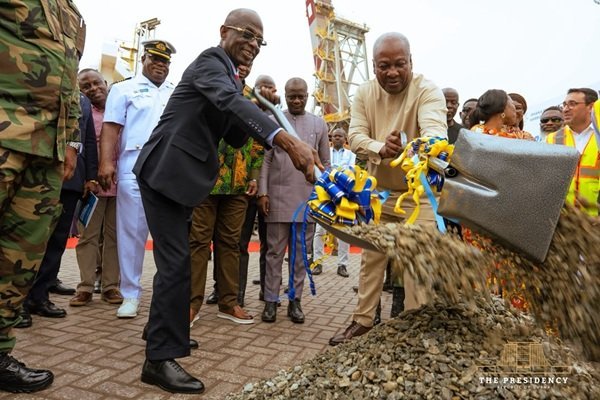
President John Dramani Mahama has cut the sod for a US$137 million floating dry dock at the Takoradi Port, a facility the government says will turn Ghana into a ship repair and maintenance centre for West Africa.
The ceremony took place in Takoradi on Tuesday. Ghanaian Times reported that the project is being delivered under a 25-year concession and is expected to be completed within 18 months.
What a floating dry dock does
A dry dock is where a ship is lifted out of the water so work can be done on the parts of the hull that normally sit below the surface. A floating dry dock does the same job but is itself a vessel: it sinks partly into the water, the ship moves in, and the dock is then pumped out and raised with the ship sitting on it.
That makes it useful at ports like Takoradi, where building a permanent concrete dock would be far more expensive and take much longer.
Why Ghana wants it
The main argument the President made is about distance and cost. Vessels working along the Gulf of Guinea currently have to sail to Europe or to Durban in South Africa when they need major repairs.
"I know that on the whole of the West Coast, actually the Gulf Coast, there is no major ship repair facility," Mr Mahama said at the ceremony.
Every one of those long trips means fuel, crew time and weeks out of service — and repair fees paid to yards in other countries. A working dock at Takoradi would give ship owners a nearer option.
The facility is intended to serve more than cargo ships. The government says it will also handle oil rigs and other maritime vessels operating along the West African coast and beyond. That matters for Takoradi in particular, which sits close to Ghana's offshore oil fields and already functions as the base for much of the country's upstream petroleum activity.
What to watch next
The clearest test is the timeline. An 18-month build would put completion in 2028 if work starts without delay. Sod-cutting ceremonies in Ghana have not always been followed quickly by construction, so the pace of the first year will be telling.
The second thing to watch is the concession itself. A 25-year arrangement means a private operator will run the facility for a long period. The source report does not name the concessionaire or set out how revenue will be shared, and those details will shape how much Ghana actually earns from the investment.
For Ghanaians abroad, particularly those tracking the country's industrial and energy sectors, the project is part of a broader push to capture more value from activity that already happens off Ghana's coast rather than exporting the work elsewhere.