
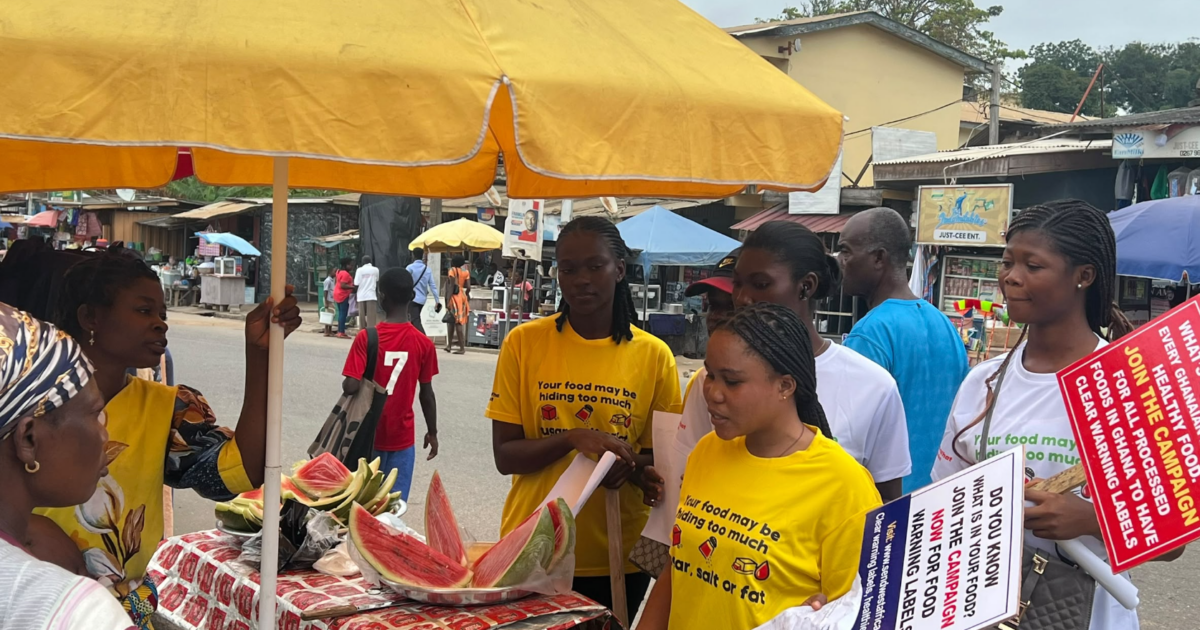
Campaigners say simple front-of-pack warnings would help shoppers spot foods high in sugar, salt and fat before they buy.
Students and campaigners took to the streets of Cape Coast on Wednesday to demand that Ghana make warning labels compulsory on the front of packaged food.
The float was organised by SEND-Ghana, a policy advocacy organisation, together with the Department of Food and Nutrition at the University of Cape Coast (UCC). Marchers moved from the UCC campus into surrounding communities including Amamoma, Kwaprow, Abura and Kotokuraba, handing out flyers to residents.
The theme chosen for the day was blunt: "Your food may be hiding too much sugar, salt or fat." Placards carried by participants made the same point, with one reading, "Four million Ghanaians have diabetes, we need food warning labels."
What front-of-pack labelling means
Front-of-Pack Warning Labelling (FOPWL) is a system where a clear notice is printed on the front of a package to tell the buyer that the product is high in a particular nutrient, such as sugar, salt or unhealthy fat.
It is different from the detailed nutrition table usually printed in small letters on the back of a pack. The argument from campaigners is that most shoppers do not read or understand those tables, while a bold front label can be understood in seconds.
Ghana already requires pre-packaged foods to carry labels, but there is no rule forcing producers to display a simple, standardised warning on the front.
What campaigners want
Speaking to the Ghana News Agency, as reported by MyJoyOnline, SEND-Ghana's Communication Officer, Joana Ankomaa Addey, said a mandatory system would particularly help children and other vulnerable groups identify products loaded with sugar, salt and unhealthy fats.
She said the policy would cut the risk of diet-related non-communicable diseases (NCDs)
covering conditions such as diabetes, hypertension and heart disease. These are illnesses that are not passed from person to person but build up over time, often linked to diet and lifestyle.
Ms Addey said it was a problem that the country still has no working policy on standardised front-of-pack warnings even as diet-related NCDs and kidney disease rise. She urged government to speed up work on a mandatory policy.
Samuel Mbilka Smart, President of the Ghana Association of Food and Nutrition Students at UCC, also backed the call. He said a "high in" label lets a shopper make a healthier choice at a glance, without needing any training in nutrition.
He added that this would ease the growing cost of NCDs on families, the health system and the country.
Why it matters
For Ghanaians abroad who send money home or buy Ghanaian products, the debate touches a familiar concern: what is actually inside the processed food on the shelf. Several countries have already adopted warning-label systems. Campaigners want Ghana to follow, and the next step rests with government.
Residents along the route were said to have received the flyers and asked questions about checking nutrition content before buying.